Cooking Spree: Skinny Banana "Ice Cream"

Consider my mind blown.

A few weeks back, when I was still on the wagon and trying to eat sensibly, Stephanie told me about skinny banana ice cream. You just blend a frozen banana in a food processor, she said, and voila! You have a dessert-like treat with the consistency of soft serve. Nah, I doubted. There’s no way a measly frozen banana can trick my brain into believing I’m eating ice cream.

Then I tried it.

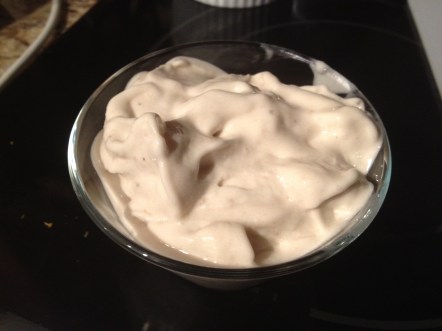
The result is everything she promised — smooth, creamy, sweet, icy. You totally feel like you’re eating banana ice cream, but with zero guilt.

I heard recently that bananas and mangoes are the only fruits that maintain a creamy consistency when frozen, so the science does make sense. And I suppose that means frozen mangoes are next on my shopping list.
————————————————–

Skinny Banana “Ice Cream”

1 frozen banana
1 tablespoon milk
Honey or sugar, to taste (if you’d like)

Equipment: small food processor or blender

Peel a medium banana (or a few bananas) and place it in a large ziploc bag. Freeze for a couple of hours until solid.

Remove a banana from the plastic bag and, (carefully!) with a sharp knife, chop it into chunks.

Note: I stress again — be careful! The banana may be hard to chop while frozen. You could chop the banana before you freeze it but I didn’t because I wanted to easily see a one banana portion. You could portion banana slices into different bags or bowls before freezing, though. Hey, I’m lazy. 

Add the banana to the bowl of a food processor or blender. Add the milk. At this point, you could add sweetener — a touch of honey, sugar or sweetener packet, though I didn’t. I suppose you could also add some yogurt — plain, vanilla or Greek — but you do need the liquid of the milk to help the banana blend.

Blend the banana and milk in the food processor/blender for about a minute. The consistency will change and it will become smooth and soft, like frozen yogurt or soft-serve ice cream. Working quickly, pour the “ice cream” into a bowl and eat.


Buttermilk Pie: The Experiment, Part II

It’s been busy days here around Constitution Lane, but I realized I need to tell you about the second part of my buttermilk pie baking experiment!

I’m always on the hunt for a good pie crust recipe — and nothing but homemade will do. If you’ve ever read the label on those ready-made, refrigerated crusts at the grocery, you’d probably join me in that. Handmade pie crust does require more labor and time, but not as much as you think. Plus, the finished product isn’t even comparable to crust in a box, and making it by hand lets you work out some aggression and build some arm strength. Always a positive.

I confess that pie isn’t really my go-to dessert — I’m much more of a cake (and frosting!) girl — but I bake a few at Thanksgiving and call on the same pie crust recipes when I make quiche to use up fresh vegetables. I’ve encountered a lot of different pie crust recipes in my time, with all manner of butter-shortening combinations. I find vegetable shortening to be kind of icky in its slick, opaque greasiness, and I just don’t feel right about using it in my food. But pie crust experts will tell you it’s a necessity for proper crust flakiness. Okay, okay. In my last few pie bakings, I’ve used shortening but always very sparingly. I reduce it to a tablespoon or two and make up the rest with butter. I know, I’m so rebellious.

The recipe I used last Thanksgiving was the best yet, and I was prepared to let that be the end all, be all. Until I read about the vodka pie crust.
Keep reading »

Buttermilk Pie: The Experiment, Part I

I’ve been catching up on episodes of “Who Do You Think You Are?” this week, which always makes me think of my own roots and family history. The truth is I couldn’t be more southern. My mom was raised in the lowcountry of South Carolina, and my maternal roots go several centuries deep in Savannah. My dad is from the Pee Dee area of South Carolina, and we can trace my paternal ancestry back to colonial times in eastern North Carolina and Virginia. I was raised near Charlotte, N.C. — so, like my mom says, we haven’t moved very far.

My exposure to the cuisine of the South while I was growing up included staple recipes that had been in my family and the classics we ate in family-run restaurants. I grew to love food that most southern families have enjoyed for centuries: puckeringly sweet iced tea, fresh figs off the tree, blackberries on the vine and homegrown, road stand vegetables like deep, red tomatoes and fuzzy, tender, juicy peaches. In the fall we picked up pecans under the ancient tree that canopied my grandparents’ backyard and cracked and shelled them inside by the fire. At home we ate fried quail or fish with grits for breakfast, country-style steak with rice, chicken bog, boiled peanuts, slow-cooked collard greens, red velvet and caramel cakes … the list goes on.
Keep reading »

Using what you have on hand.

I have entered the week quite exhausted and out of sorts — the drama of the fire on Saturday didn’t help, then I classically overscheduled myself on Sunday. I had committed to volunteering in the afternoon, which I always enjoy, followed by a Super Bowl party that evening. Somehow I just ran late all day, leaving me distracted and mentally tired, both at those events and in easing back into the work week. The good news is that I perfected a new recipe and have been able to feed my stress with sweet, spicy, chocolatey goodness.

Keep reading »

Culinary Bucket List: Rhubarb

Somehow in my more than 30 years (ahem) on this planet I have missed (escaped?) a run-in with that lithe, fuchsia vegetable known as rhubarb. Sure, I know what it is and what it looks like. I know people bake with it, and that it is often married with strawberries and featured in things called “slumps” and “grunts,” or more familiarly, crumbs, crisps and pies. I’ve never actually had the pleasure (?) myself, though.

I sort of despise celery, unless it’s well cloaked in soup or sauce, so avoidance of rhubarb in its resemblance to pink celery could have been unconscious. That certainly doesn’t endear me to it.

But people seem to speak of rhubarb with a certain reverence — as a plucky little vegetable that transforms from a crunchy and bitter stalk to a tart, soft compote. It creates desserts that we associate with our heritage, like those old English puddings and American-settler era fruit crisps. I’ve heard rhubarb described as “what tart would smell like, if tart were a smell.”*
Keep reading »